
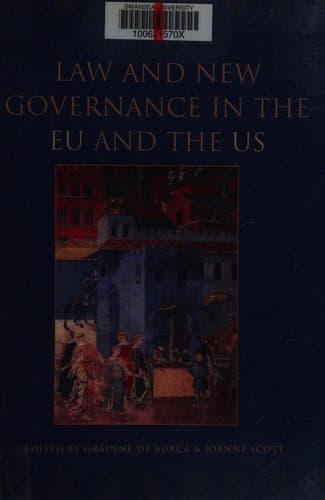
Law and new governance in the EU and the US
New approaches to governance have attracted significant scholarly attention in recent years. Commentators on both sides of the Atlantic have identified, charted and evaluated the rise and spread of forms of governance, forms which seem to differ from previous regulatory and legal paradigms. In Europe, the emergence of the Open Method of Coordination has provided a focal point for new governance studies. In the US, scholarship on issues such as collaborative problem-solving, democratic experimentalism, and problem-solving courts exemplify the interest in similar developments. This book covers diverse policy sectors and subjects, including the environment, education, anti-discrimination, food safety and many others. While some chapters concentrate on the operation of new governance mechanisms in a federal and multilevel context and others look at the relationship between public and private mechanisms and settings, what all the contributors share in common is the pursuit of effective mechanisms for addressing complex social problems, and the challenges they raise for our understanding of law and constitutionalism, and of legal and constitutional values
Sign in to add this book to your list.
What critics are saying
Verdicts use the same scale as your list: highly recommended through avoid — plus optional scores and blurbs.
Nobody on Critic, Sir! has logged a verdict for this title yet. The silence is either respectful or suspicious.
Sign in and use Add to My List below to share your own verdict.
Reading Lists
Sign in to create and edit public lists.
Loading lists…
Purchase & Discovery
Find this title on Amazon
Physical edition
All Books (physical editions)Search on AmazonOfficial merchandise
Official-style merch searchApparel, collectibles, and moreAs an Amazon Associate, Critic, Sir! earns from qualifying purchases. Full disclosure